
Can I Learn NLP in a Week?
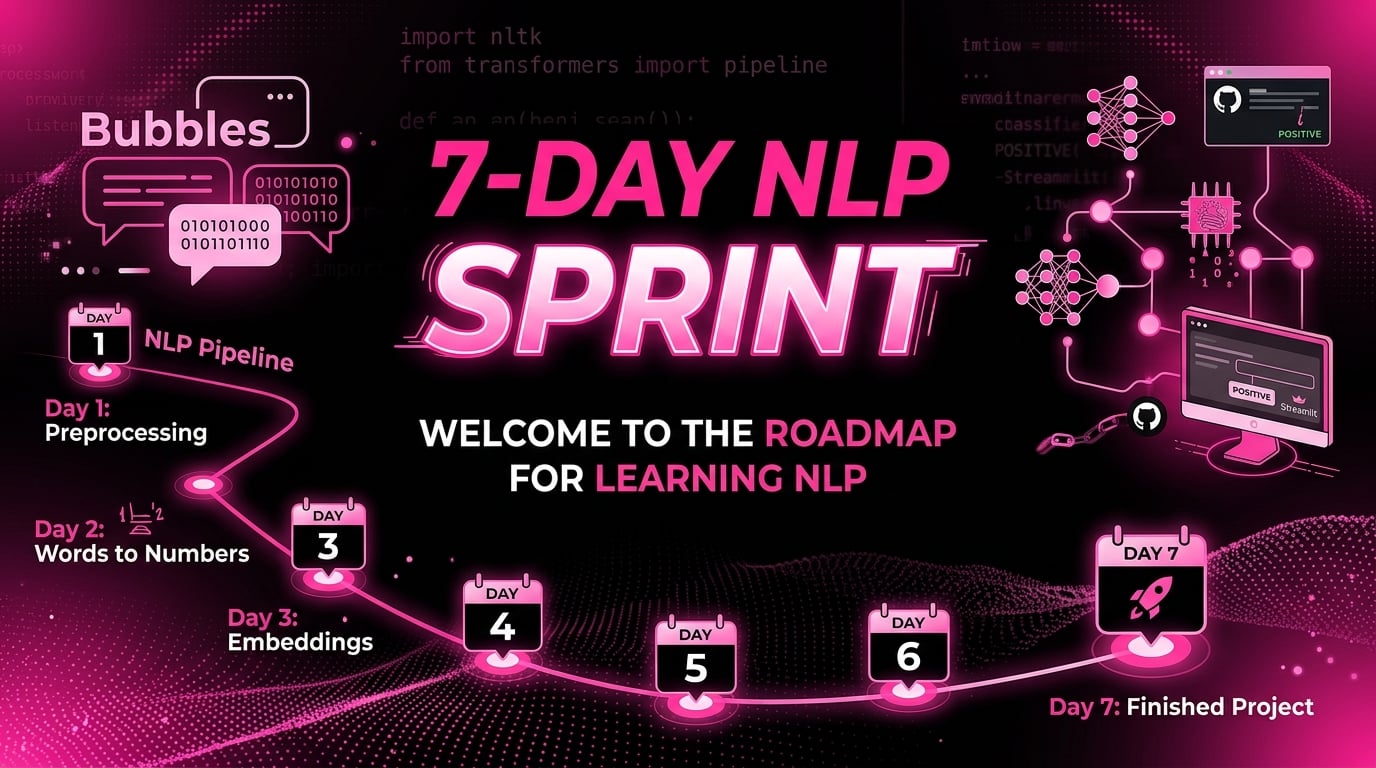
Welcome to another blog post where we come together to create a 7-day roadmap for our iconic 7 day Natural Language Processing Sprint.
So, what is NLP?
Formally, Natural Language Processing (NLP) is a field of AI that helps computers understand, interpret, and generate human language. Basically, it's about teaching computers how to work with the way humans communicate.
And this doesn't just mean English. NLP can be applied to languages spoken all over the world, from Spanish and French to Zulu and my very own language, Shona.
NLP is a field of AI, just like Machine Learning and Robotics. So naturally, the question is: can I learn NLP in a week?
One may ask, why are we trying to learn NLP in a week? Well, learning isn't easy, especially in University. So this is going to be a fun, no pressure sprint to see how far we can get. And at the end of these 7 days, I'm pretty sure we'll know more about NLP than we started, and that's what's important.
Disclaimer
PLEASE TAKE NOTE. This isn't about going from knowing nothing about NLP to mastering the entire field in seven days. That would be incredibly unrealistic.
Instead, I'm treating this as a focused learning experiment. I'll start with basic NLP knowledge and aim to finish the week as someone who can understand the core NLP pipeline, build a small NLP project, evaluate it, and explain what I built.
In other words:
Day 0: I know the basics of NLP. Day 7: I can build, explain, evaluate, and demo an NLP project.
Below is the plan, the resources I'll use, and the projects I'll attempt at each milestone.
Day 1: What Is NLP?
The goal for Day 1 is to understand what Natural Language Processing actually is and how computers represent human language.
I'll learn about:
What NLP is, and NLP vs. LLMs
Common NLP tasks: text classification, sentiment analysis, Named Entity Recognition (NER), translation, summarization, question answering
Text as data — sentences, words, tokens, vocabulary
Basic preprocessing and stopwords
Resources: Dr. W.J.B. Mattingly’s full-length Natural Language Processing with spaCy & Python course on freeCodeCamp for a detailed overview of NLP fundamentals and core text preprocessing; the NLTK Book for hands-on tokenization, stopwords, stemming, lemmatization, frequency distributions, and corpora; and spaCy's documentation to see how a modern library handles production tokenization, POS tagging, dependency parsing, and NER. I don't need to master every spaCy feature today just to understand what a pipeline looks like in practice. I will also do a free short spaCy course.
What I'll build: I'll take 5–10 pieces of text and run them through a basic preprocessing pipeline, first with NLTK, then experiment with the equivalent concepts in spaCy:
Raw text → Lowercase → Tokenize → Remove noise →
Remove stopwords → Stemming / Lemmatization → Word-frequency analysis
By the end of the day, I should have a clearer answer to: what actually happens to text before an NLP model can work with it?
Resources for Day 1: Dr. W.J.B. Mattingly’s full-length Natural Language Processing with spaCy & Python course& Python course , NLTK Book, spaCy Documentation, spaCy Course.
Day 2: Turning Words Into Numbers
The goal for day 2 is to understand how traditional machine-learning algorithms work with text, I don't want to jump straight into Hugging Face pipelines without knowing what's underneath. It's like learning the mechanics of a car first, so that I can appreciate it more when I start using it.
I'll learn about: Bag of Words, vocabulary, word counts, n-grams, TF-IDF, sparse vectors, and train/test splitting, then build a simple text classifier:
Text → TF-IDF → Logistic Regression / Naive Bayes → Prediction
For example: "This movie was absolutely amazing." → Positive
Resource: scikit-learn's Working With Text Data tutorial, which follows the practical process of turning documents into feature vectors and training a classifier.
Main question: how does a sentence become something a model can actually process?
Resources for Day 2: Working With Text Data Tutorial
Day 3: Embeddings; Giving Words Meaning
So far I'll have treated words mostly as counts. Now I'll move toward representations that capture relationships between words.
I'll learn about: limitations of Bag of Words, word embeddings, Word2Vec, CBOW, skip-gram, semantic similarity, and cosine similarity.
The conceptual jump:
Bag of Words: "I know how often this word occurs." Embeddings: "I can represent relationships between words."
Resource: Stanford's CS224N, used selectively, not the whole course, just the parts on word vectors and embeddings when I need a deeper explanation.
Experiment: I'll play with pretrained embeddings and explore relationships between words like king, queen, doctor, nurse, Zimbabwe, Harare, AI, machine learning, not for serious research, just to build intuition for what it means for two words to have similar representations.
Resources for Day 3: Stanford's CS224N
Day 4: Neural Networks for NLP
This is where I'll connect NLP to deep-learning concepts I already know. So excited for day 4.
I'll explore: embeddings as neural-network inputs, sequential data, RNNs, LSTMs, GRUs, why sequence modelling matters, and the limitations of RNNs.
I'll aim to build a small sentiment classifier:
Text → Tokenization → Embedding → LSTM / GRU → Dense layer → Positive / Negative
Resource: back to CS224N for the neural-NLP material.
The goal isn't the world's greatest LSTM, it's simply: can I actually build an NLP neural network myself?
Resources for Day 4: Stanford's CS224N
Day 5: Transformers
Probably the biggest conceptual jump of the week. But what is NLP in 2026 without Transformers?
I'll learn about: why RNNs weren't enough, attention and self-attention, Query/Key/Value, positional information, encoder vs. decoder, the Transformer architecture, BERT vs. GPT at a high level, and pretrained models.
Resource: the Hugging Face Course, especially its early sections on Transformers, tokenizers, datasets, pretrained models, and fine-tuning. I won't try to derive every matrix multiplication behind attention, the goal is to understand roughly what a Transformer is doing, and to actually use one:
from transformers import pipeline
classifier = pipeline("sentiment-analysis")
classifier("I absolutely love this!")
This will be my first real interaction with a modern Transformer-based model.
Side note: In one of my freshman courses, Introduction to Artificial Intelligence, Machine Learning and Data Science, one of the topics was NLP. The first time I heard the word transformers during this class, I was shocked, in a good and excited way. I was like, "There is absolutely no way I'm learning how to make THE OPTIMUS PRIME, AND BUMBLEBEE, AND FRIENDS in this course. Childhood dream come true." But oh how I was wrong. These Transformers are not the transformers that you and I grew up watching.
Resources for Day 5: Hugging Face Course
Day 6: Build Day
Time to stop jumping between tutorials and pick one project to build:
Sentiment analyzer — "The service was terrible." → Negative, 96%
Student feedback classifier — "The lecturer explains concepts clearly." → Teaching / Positive; "The Wi-Fi has been down for three days." → Infrastructure / Complaint
Zimbabwean news classifier — sorting articles into Technology, Business, Politics, Sports, Education, Entertainment
Named entity recognition — "Econet announced a new AI initiative in Harare." → Econet (ORGANIZATION), Harare (LOCATION), using spaCy's NER pipeline
I won't build all four, even though my high achiever self really wants to do all of them. I'll pick one and finish it. This will be the moment I actually apply everything I've been learning the previous 5 days to make an actual NLP project.
Day 7: Turning It Into a Real Project
Day 7 is about turning whatever I build on Day 6 into something I can actually show someone.
Structure:
project/
├── data/
├── notebooks/
├── src/
├── app/
├── README.md
└── requirements.txt
Evaluate it properly. Instead of "it seems to work," I'll measure accuracy, precision, recall, F1-score, and use a confusion matrix and test it on examples outside the training data, including deliberately weird or ambiguous ones.
Build a tiny interface, probably in Streamlit, or using html and css. As long as it looks amazing:
┌──────────────────────────────┐
│       NLP Classifier         │
│ Enter text:                  │
│ ┌──────────────────────────┐ │
│ │ This service is amazing! │ │
│ └──────────────────────────┘ │
│        [ ANALYSE ]           │
│ Prediction: POSITIVE         │
│ Confidence: 94%              │
└──────────────────────────────┘
Ship it to GitHub, with a README covering what I learned, what I built, the dataset, the model, results, limitations, and what I'd improve next.
That's the difference between following an NLP tutorial and actually having an NLP project.
The Resource Stack
I don't want this to turn into 47 bookmarked tutorials I never finish, so the stack stays small:
CampusX — NLP Beginner Series (or Codebasics — NLP Tutorial for Beginners in Python as an alternative; I'll pick one, not both)
NLTK Book — classical NLP concepts and hands-on text processing
scikit-learn Text Analytics Tutorial — TF-IDF and traditional ML text classification
Stanford CS224N — deeper explanations of embeddings and neural NLP, used selectively
Hugging Face Course — Transformers, tokenizers, pretrained models, datasets
spaCy Documentation and course — practical NLP tasks like NER and linguistic processing
What I Won't Study Yet
Seven days isn't enough to cover all of NLP, and trying to would defeat the point of the experiment, and also drive me closer to burnout. I have deliberately left these for later: dependency and constituency parsing in depth, CRFs, HMM derivations, BLEU mathematics, machine translation architectures, speech NLP, RLHF, LLM pretraining, LoRA/QLoRA, distributed training, multimodal NLP, and deep research-paper rabbit holes.
These aren't useless, they're just not part of this experiment. And our goal for this is to be able to make something in NLP, not become an NLP master.
The Progression
Day 1  What is language processing?
   ↓
Day 2  How do computers turn words into numbers?
   ↓
Day 3  How can numbers represent meaning?
   ↓
Day 4  Can neural networks understand sequences?
   ↓
Day 5  Why did Transformers change NLP?
   ↓
Day 6  Can I actually build something?
   ↓
Day 7  Can I turn it into a real project?
And that's what I'll be testing. Not "can I master NLP in seven days?", that would be ridiculous. The real question is: after seven days, will I be able to look at an NLP problem, understand the basic pipeline, choose an approach, build a working prototype, evaluate it, and explain what I did?
I'll find out. This is going to be a genuinely harrowing week, the kind that tests whether you actually want to stay in tech and makes me rethink my life choices, which I have done multiple times in my very short time in tech. But we're doing it anyway.
And hopefully, you can use this roadmap too.
This 7-day sprint begins now. See you in exactly 7 days for the results.